

The conversation that stayed with me
Over lunch at the ACHSM Congress in Cairns, several healthcare leaders from outside aged care told me they had come away from the aged care stream feeling thoroughly dispirited. Some joked that they needed an “antidepressant pill”.
Their question was serious. They had heard a great deal about the pressures. They were struggling to see a convincing proposition for changing the situation.
These were informal conversations, and they do not represent every delegate or presentation. But I understood the frustration. I have worked in and around healthcare and aged care for more than 30 years, first as a nurse and later in operational, governance and innovation roles. I recognise the exhaustion behind the sector’s language. I also worry about what happens when that language leaves us feeling that nothing meaningful is within our control.
We need to talk honestly about money. We also need to talk about how we organise work, where we place authority, what we do with staff knowledge and why an improvement in one service so often stays in that service.
My concern is that dependence on public funding can become a habit of waiting for government to supply the next answer. That is a leadership problem worth examining. Adequate public funding remains essential. Our responsibility to improve how we use it remains essential too.
This article explores both responsibilities. It is also an invitation to help build the Care Economy Collective, because I would like the conversation after the conference to lead to something people can use.
First we need to agree what viable means
A service can survive this month and still be unable to replace its buildings. A provider can report a group surplus while individual care services lose money. A workforce can keep a home functioning by absorbing the cost through unpaid effort and exhaustion. Each can look sustainable until it stops working.
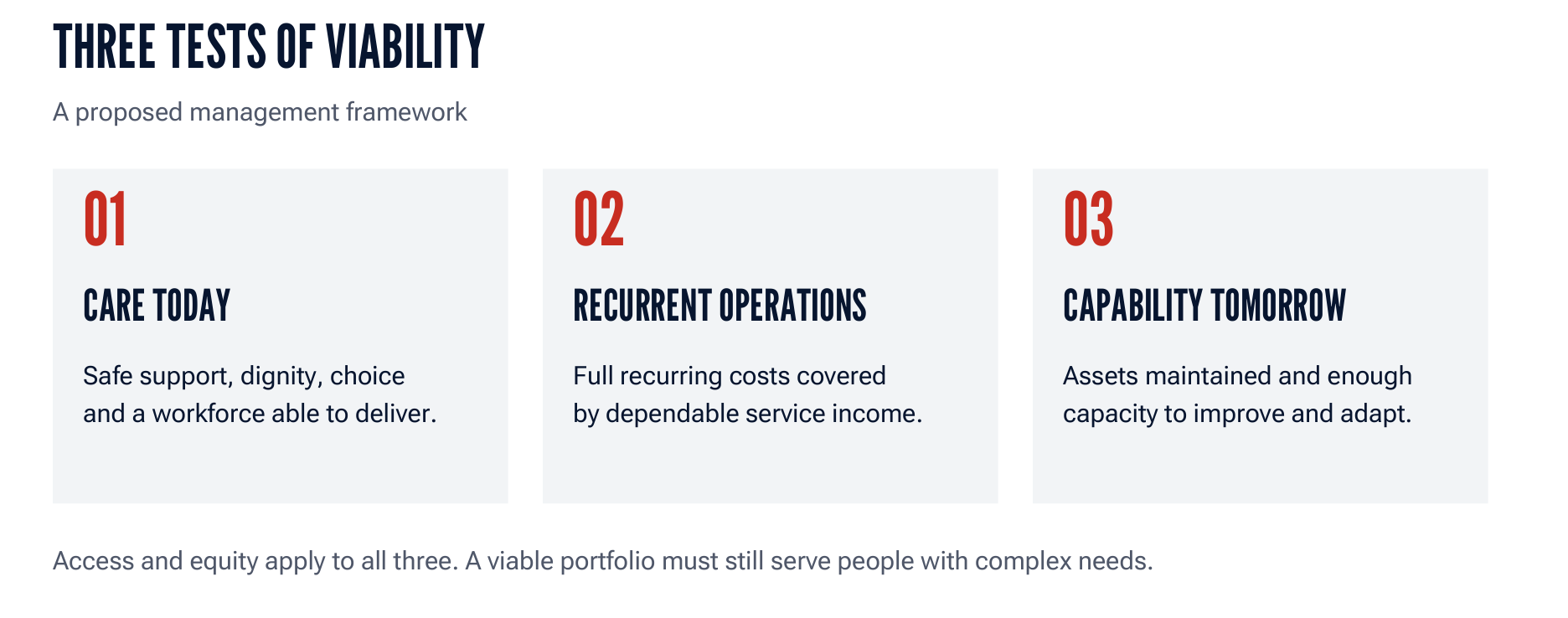
I would assess viability through three questions. Can we deliver safe, person-centred care today? Can recurrent income cover the full cost of doing that work, including proper staffing and support? Can the organisation maintain its assets and invest in the capability needed for tomorrow?
Those questions also need an access test. A business model that works by avoiding people with complex needs, or withdrawing from communities with limited alternatives, may improve a portfolio result while making the care system less useful.
We should be interested in surpluses. A surplus can fund equipment, learning, maintenance and better services. We should be just as interested in what produced it, whether it is repeatable and what the people receiving care experienced along the way.
How the sector can be profitable and still be struggling
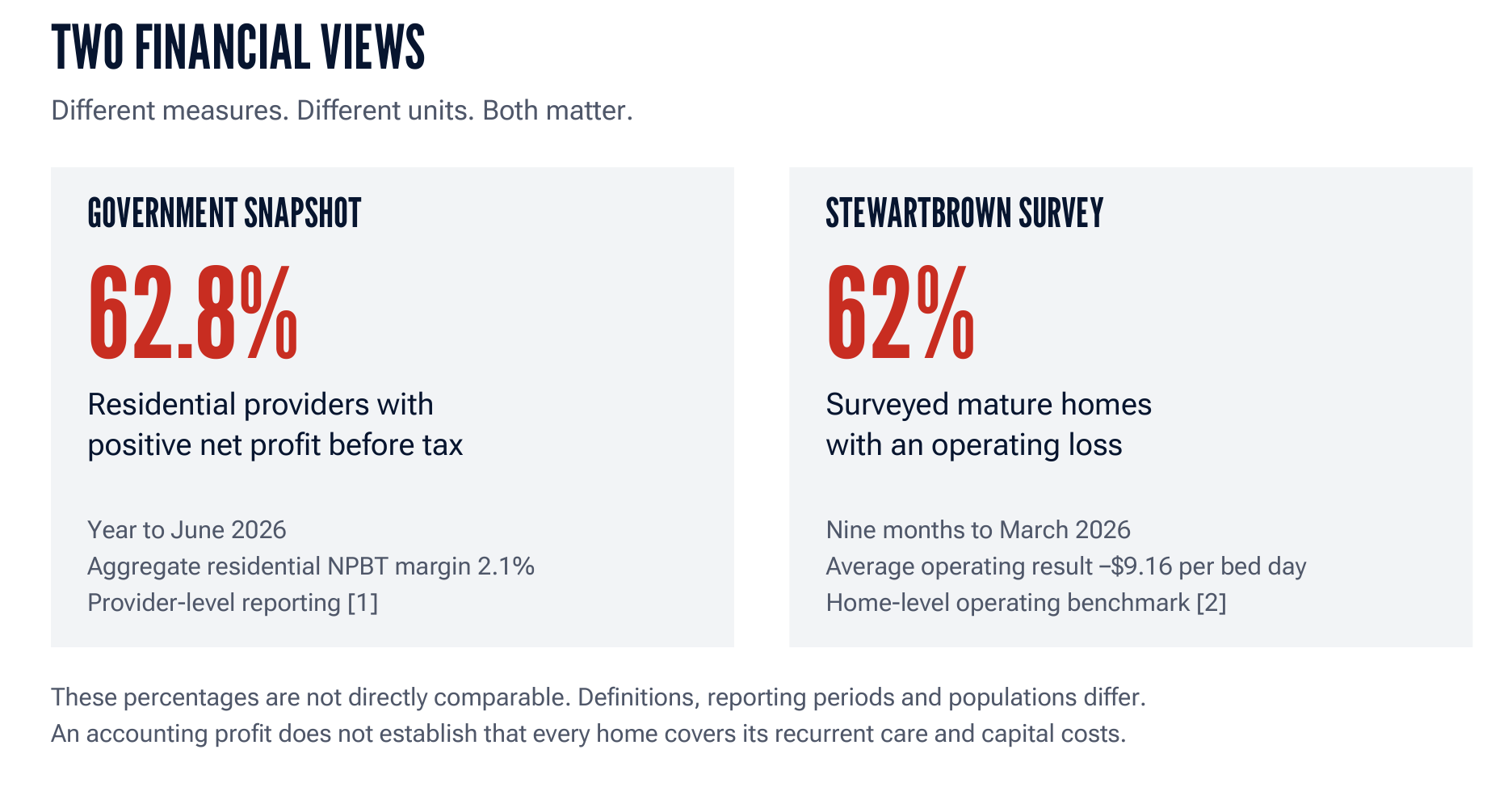
The latest government snapshot reports that 62.8% of residential providers were profitable on a net profit before tax basis in the year to June 2026. The aggregate residential pre-tax margin was 2.1%, down from 3.5%. Support at Home’s aggregate margin was 4.3%, down from 7.0%. These are provider-level financial results.[1]
StewartBrown’s nine-month survey to March 2026 tells a different part of the story: 62% of surveyed mature homes made an operating loss, with an average operating deficit of $9.16 per bed day. Its overall survey covered 1,173 homes. The operating measure excludes financing interest and investment income and non-recurrent items.[2]
Those findings can coexist. They use different reporting periods, populations, units of analysis and definitions of profit. We should not turn them into competing slogans about whether the sector is doing well or doing badly.
The distinction matters in a boardroom. If the underlying service loses money but property or investment movements support the group result, the care model still needs attention. Equally, a provider may be investing in a service before it reaches a stable occupancy or utilisation level. One disappointing year does not tell us everything about its future.
What I want to see is a bridge between the reported result and the economics of care: what is recurring, what comes from financing or assets, what was a one-off, and which services can actually fund their own upkeep. That is where a useful viability discussion begins.
What four Australian providers help us understand
There are financially positive providers in Australia. There are also instructive cases where a headline result conceals a more difficult operating picture. I have chosen four public examples to examine those differences. They are financial cases, not a ranking of care quality.
Regis shows that positive earnings and continued cost pressure can coexist
Regis reported FY26 statutory net profit after tax of $55.7 million and underlying EBITDA of $138.0 million. Mature-home average occupancy was 96.0%. Its underlying EBITDA margin nevertheless fell from 10.8% to 10.2%. The company attributed revenue growth to funding changes, acquisitions and occupancy; it also reported $250.5 million in net refundable accommodation deposit cash inflows.[3]
My reading is that occupancy management, service capacity, capital access and execution deserve attention alongside funding. The result does not tell us how much any particular innovation contributed. Deposit inflows also need to be read alongside the obligation to repay residents; they are not free operating income. For another provider, the useful task is to identify which operating practices can travel and which advantages depend on its own assets, market and scale.
Bolton Clarke shows why group strength needs to be unpacked
Bolton Clarke reported FY25 operating EBITDA of $151.0 million and a statutory net surplus of $15.6 million. Its accounts also record a $107.3 million retirement-village valuation uplift, partly offset by residents’ share, as well as integration and employee-entitlement remediation expenses.[4]
A large organisation has opportunities to share expertise, purchasing and systems across services. It also carries integration costs and organisational complexity. We should examine both. Its group result is useful evidence of financial capacity, but it cannot be treated as the margin earned by an individual aged care home or as proof that scale alone improves performance.
HammondCare shows the gap between mission and a dependable care margin
HammondCare’s FY25 underlying group surplus was $1.2 million. Residential care recorded a $1.4 million deficit, improved from a $2.2 million deficit the previous year. The annual report says it delivered 236 care minutes per resident per day against a 215-minute target.[5]
This is why I am cautious about assuming a respected care model must also have solved the economics. A provider can be investing seriously in care and still have a narrow financial position. The question for leaders is how to fund the care model consistently, including its support services, without relying indefinitely on another part of the organisation to absorb the gap.
Australian Unity shows why investment needs follow-through
Australian Unity’s FY26 residential aged care adjusted EBITDA was $32.9 million, compared with $54.8 million in FY25. The prior year included $18.3 million in non-recurring valuation gains. The group reported a $155.2 million statutory loss and described external funding disruption alongside transformation programmes that proved more complex, costly and slower to deliver benefits than anticipated.[6]
There is a useful lesson here for those of us who advocate innovation. Funding pressure and execution problems can exist in the same organisation. Buying systems, integrating businesses and building capacity ahead of demand require explicit assumptions and active oversight. We need to be willing to revise those assumptions when the expected benefit does not arrive.
| Provider and period | Financial measure | What a reader can infer |
|---|---|---|
| Regis FY26 | Group NPAT $55.7m; underlying EBITDA $138.0m. [3] | Positive group earnings. Margin, care quality and innovation impact need separate assessment. |
| Bolton Clarke FY25 | Group net surplus $15.6m; operating EBITDA $151.0m. [4] | Financial capacity with material non-operating and integration effects. |
| HammondCare FY25 | Underlying group surplus $1.2m; residential deficit $1.4m. [5] | Group and care-business sustainability can differ. |
| Australian Unity FY26 | Residential adjusted EBITDA $32.9m; group loss $155.2m. [6] | Segment earnings, valuations and group outcomes are distinct. |
Why better examples have not become everyday practice
I do not think there is one explanation. Several problems reinforce each other, and each calls for a different response.
Care costs and service obligations do not move neatly with income
People’s needs do not wait for an indexation date. Recruitment can require agency cover. A safe roster must operate overnight even when several rooms are empty. In home care, travelling between people, managing cancellations and keeping enough staff available can undermine the economics of otherwise busy services.
These are operating realities to model, not excuses to dismiss. A large metropolitan home and a small rural service should not be expected to solve identical problems through identical methods. Where the structural cost exceeds a reasonable service price, policy intervention may be necessary.
We confuse the cost of care with the cost of our operating model
An older person’s need for assistance is a care requirement. Entering the same information into several disconnected systems is a design choice, even when nobody deliberately chose the final arrangement. So is an approval that waits for three managers or a handover that leaves the next shift searching for what changed.
The distinction is important because cuts applied across the whole budget can remove useful care while leaving avoidable complexity intact. I would first want to understand where staff time goes, which controls protect people and which steps simply compensate for weaknesses elsewhere.
The person who sees the problem often cannot authorise the fix
A support worker may know why breakfast routinely clashes with personal care. A nurse may see that an escalation disappears between shifts. A scheduler may know which cancellation rule creates unnecessary travel. The insight is already there, but the authority, technical help and budget sit somewhere else.
An idea-submission form will not close that gap on its own. People need feedback, protected time and a manager who can help them work across boundaries. Otherwise we teach staff that raising a problem creates more work for them without changing anything.
The benefit and the bill can sit in different organisations
A better hospital-to-home transition may require extra coordination from a community provider while reducing work or admissions elsewhere. The older person benefits, but the investing service may struggle to recover its cost. Collaboration therefore needs a practical arrangement for resources and accountability, not simply agreement that integration is desirable.
We pay repeatedly for learning that could be shared
A provider tests a new workflow, discovers three things that do not work and eventually makes it useful. Another provider starts again because it can access the conference slides but not the implementation detail. The sector carries the cost of the same learning several times.
Shared evidence needs to include the starting conditions, staff effort, failures, full costs and changes required after launch. Commercial interests can be protected while still explaining enough for others to judge whether the approach is relevant.
We often stop measuring at the point of installation
A system goes live. Training attendance is recorded. A pilot is labelled successful. Six months later, staff use a spreadsheet alongside it, workarounds have multiplied and nobody can explain whether the original business case still holds.
I would make someone responsible for the benefit after implementation, with permission to change or stop the approach. This is ordinary management discipline. Calling the project innovative should increase our interest in the evidence.
Stanford offers a method worth taking seriously
The Stanford Operating System interests me because it connects leadership expectations with the way daily work is improved. Stanford’s 2013 nursing report recorded a reduction in emergency department door-to-triage time from 27 minutes to nine and inpatient likelihood-to-recommend results at the 92nd national percentile during May to July. The report linked the gains to nursing-led Lean management and communication work.[7]
A 2015 peer-reviewed emergency department study describes frontline staff and physicians contributing to redesign within existing departmental resources.[8] That is the part I would take into aged care: study the work with the people doing it, identify the friction and make the response visible to management.
Imagine applying that discipline to a resident’s call bell. We would follow the whole sequence: the request, who receives it, whether the worker is already committed elsewhere, whether the required equipment is available, what happens if the request cannot be answered and how the resident knows someone is coming. A monthly response-time average would be only part of the picture.
The improvement might involve clearer task allocation, equipment placement, a different handover or better communication with residents. Some changes may require technology. Others may require a decision that has been avoided.
We should also keep Stanford’s mixed findings in view. A separate study of redesigned multidisciplinary rounds improved discharge timing and documentation without changing mean length of stay or patient satisfaction.[9] A method can improve some outcomes and leave others unchanged.
I am using Stanford as an operational improvement case. The available evidence does not establish that this approach alone rescued the hospital financially. Our test in Australia should be whether a specific change improves care and the full workflow under local conditions.
Buurtzorg asks a deeper question about authority
The Dutch home nursing organisation Buurtzorg gives us a different example. A 2025 organisational study describes small self-managing teams responsible for substantial care and operational decisions, supported by coaches, a central back office and purpose-built information technology. It also notes the importance of capable, motivated staff and the relatively low interdependence between neighbourhood teams.[10]
The transfer to aged care is not to remove managers and hope for the best. It is to ask which decisions can safely sit closer to the person receiving care, and what support makes that possible.
A team with authority over its roster still needs the skills to plan it. A team taking responsibility for improvement still needs accessible data and a way to resolve disagreements. A worker asked to make more decisions needs clear scope, supervision and a route for escalation.
For a residential provider, I would explore a bounded application, perhaps around dining, a household team or a specific transition. I would want residents involved in defining the desired experience, staff prepared for the additional responsibility and quality measures reviewed alongside cost.
The broader lesson is about organisational design. People can be made responsible for outcomes without being given enough influence over how those outcomes are produced. That mismatch deserves attention before we ask them to work harder.
Green House brings the question into residential care
The US Green House model reorganises residential care around smaller households and different staff responsibilities. Its implementation research also found differences in resident mix and higher private-pay rates in Green House homes than in associated traditional units. The physical setting, staffing approach and revenue assumptions all matter when judging whether a model can transfer.[18]
A 2016 study compared 15 adopting organisations with 223 matched non-adopters. It found no detectable overall effect on Medicare spending across all residents. A separate Green House-unit analysis suggested lower spending, but the estimate did not reach the conventional 5% significance threshold and possible increases in legacy units complicated the picture. The authors also noted that nursing homes would not receive any related Medicare savings under traditional payment arrangements.[17]
I would take this as a reason to ask better questions about who pays and who benefits. A household approach needs to be evaluated through residents’ daily lives, workforce design, service costs and the economics of the whole provider. We should be interested in it without turning one favourable finding into a guaranteed saving.
How hospitals turn staff knowledge into new capability
There is another opportunity beyond making an existing workflow better. Some solutions developed inside a service may be useful to other services. Hospitals such as Sheba, Mayo Clinic and Henry Ford have built formal ways to explore that possibility.
The relevant question is how they support the journey from recognising a problem to developing a solution that people can safely use and, in some cases, pay for.
Sheba ARC makes development part of the institution
Sheba reports that ARC spun out 20 companies in 2024, with entrepreneurship training, clinical involvement and commercialisation support contributing to that activity. It describes proceeds from commercialisation and exits being reinvested in innovation capability.[11]
On 22 October 2026, ARC Global and Redesign Health announced a merger intended to combine health-system knowledge with engineering, company-building and capital. ARC Sheba is to remain the flagship site. That expansion is an announced strategy; its future outcomes are not yet established.[12]
The mechanism worth examining is the infrastructure around the idea. Staff can draw on people who know how to develop products, evaluate them, negotiate partnerships and take a working solution beyond one hospital. The institution can benefit from value created through its expertise, rather than relying only on purchasing someone else’s product.
For aged care, the equivalent could be shared access to these capabilities across providers. It would still require development funding, patient and resident protections, sound evaluation and commercial judgement. A spin-out count or a company valuation is not the same as cash returned to a hospital or a proven improvement in care.
Mayo Clinic gives an idea somewhere to go
Mayo Clinic’s Business Development function lists intellectual property evaluation and protection, funding and development, licensing, startup formation, spin-offs and strategic partnerships among its capabilities.[13]
This matters because a clinician or care worker should not have to become an expert in contracts, product design and fundraising before anyone takes a useful idea seriously. We should be able to connect the person who understands the problem with people who can help assess and develop the response.
Henry Ford makes the incentive visible
Henry Ford Health publishes a process for invention disclosure, IP assessment, licensing and revenue distribution. Initially, inventors receive half the net commercialisation proceeds after patent expenses, with part of the institutional share returned to their department. Once distributions reach US$100,000, an additional 15% allocation to the innovation function changes the subsequent split.[14]
We do not need to copy those percentages. We do need to recognise the design choice: the contribution is acknowledged, support is organised and the terms for sharing value are visible. In aged care, a fair arrangement could include paid development time, recognition, career progression or a properly agreed financial interest.
I would also want team contributions recognised. An individual may propose a solution, but residents, care staff, administrators and colleagues can do much of the work required to make it usable. A reward structure that ignores them can damage the collaboration it was meant to encourage.
The economics need to be worked through
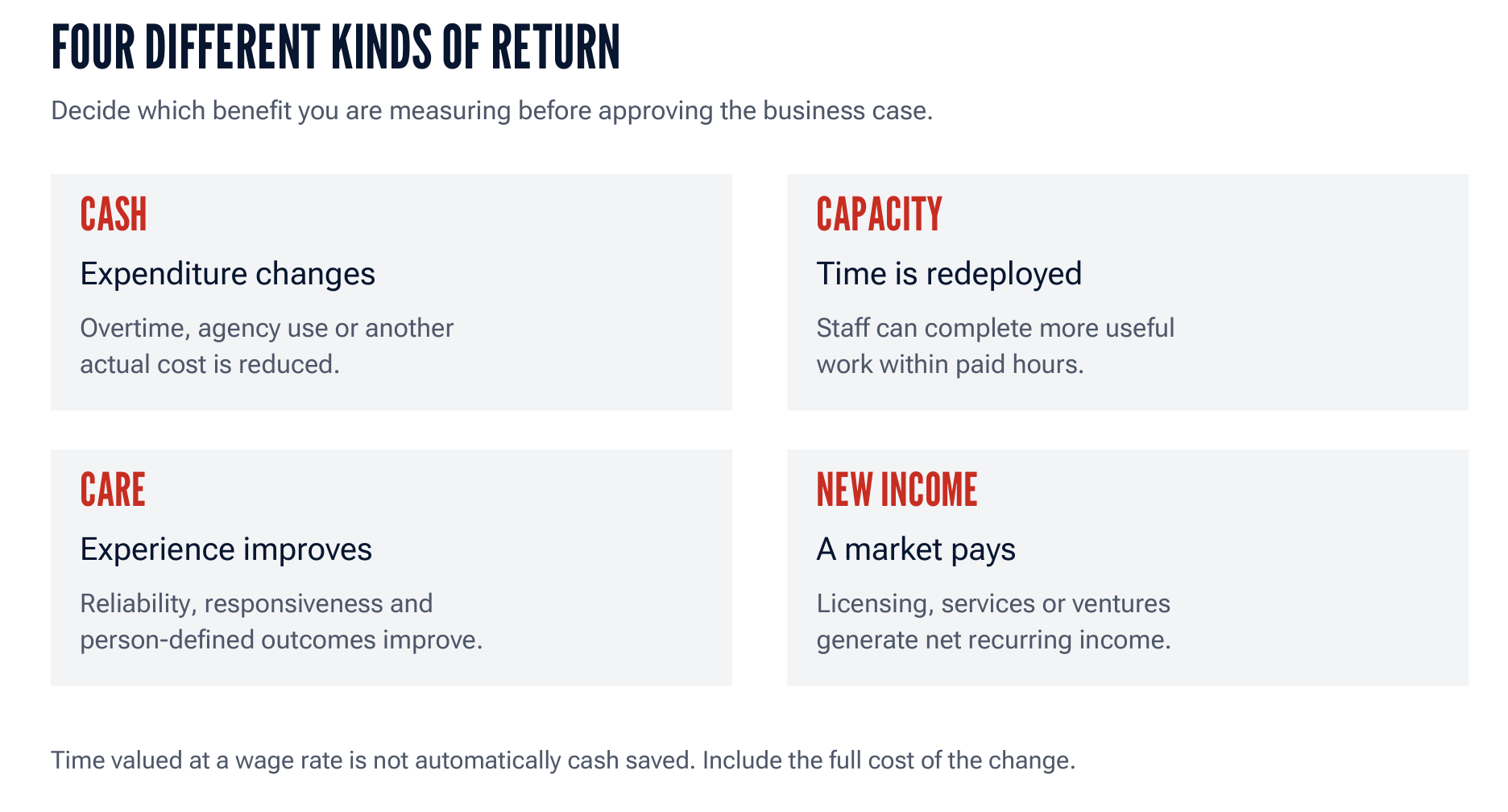
The strongest case for innovation is a clear account of what it changes. I would separate an improvement in service capacity from a reduction in expenditure, an improvement in care and income from a new product. They may occur together, but they need different evidence.
Consider an illustrative reporting workflow with 4,000 repeated events a month. If a redesign saves four minutes per event, it appears to release about 267 hours a month. Suppose verification and exception handling take 80 hours, while support and training average another 20. The net capacity released would be about 167 hours.
Those figures are assumptions for a worked example, not measured Collective results. Multiplying the hours by a wage rate gives an estimate of the capacity’s value. Cash savings arise only if an actual cost changes, such as overtime, external administration or an otherwise necessary vacancy. If staff use the time for better follow-up, we should measure that benefit instead.
Occupancy deserves the same discipline. In a hypothetical 100-bed home, moving from 90% to 95% average occupancy produces 1,825 additional occupied bed days a year. At an assumed contribution of $200 a day after additional care and service costs, that would be $365,000 towards remaining fixed costs. The assumption must include any additional staffing required; it is not gross revenue or net profit.
This is why a small operational change can matter financially, and why we need to understand its limits. Filling rooms depends on local demand, access, suitability and the service’s ability to provide the care. Reducing duplicate reporting cannot compensate indefinitely for a structurally inadequate service price.
The business case should include implementation, integration, staff backfill, checking, maintenance and the possibility of failure. It should also describe who receives the benefit. A good improvement may be worth funding even if its value does not appear as a payroll reduction.
A fair route from an idea to a shared result
I would give teams several possible destinations. A better handover or mealtime routine may be shared openly. A reusable tool may support licensing and ongoing maintenance. A genuinely distinct product may justify a separate business with its own development capital and risk.
| Route | Where it may fit | Resource and incentive question |
|---|---|---|
| Share a practice openly | A safer routine, clearer handover or reusable evaluation method. | Who maintains it, supports adoption and receives credit? |
| License and support a tool | A repeatable product with a support need across services. | Can fees fund maintenance, and are contributor terms fair? |
| Create a separate venture | A distinct product needing external capital and a wider market. | Who owns the work, bears development risk and shares value? |
For a product developed with a provider, the eventual arrangement could include a licence for the service to use it, royalties from external sales or an equity interest in a separate company. Those are options to negotiate, not benefits that automatically follow from contributing an idea. Equity may remain illiquid for years, and royalties depend on actual sales. I would want the value returned to the service and contributors calculated after development and support costs, with fair terms agreed before anyone starts assuming ownership.
The ownership and participation terms should be settled before a trial begins. Who contributes existing IP? Who owns newly developed work? Who pays for evaluation? What can be published? How are staff and lived-experience contributors recognised? These need written agreements appropriate to the work, with advice where required.
Care information should be governed separately from commercial ownership. Taking part in a service is not permission to turn someone’s personal information into a business asset. Testing needs appropriate consent, privacy protections and a clear route to raise concerns.
Commercial interests also need separation from evaluation and procurement. A provider should be able to conclude that a product it helped develop is unsuitable for wider use. The people judging that evidence need enough independence to say so.
A successful innovation model will incur costs before it generates income. Many ideas will be better as local improvements, and some will fail. Licensing and spin-outs may diversify income over time; they should not be written into next year’s care budget as a dependable rescue.
This is the work I want the Collective to make possible
The Care Economy Collective is a founding initiative I am convening through SMPLS INNOVATION. The site brings together practical tools, evidence and an invitation for people across care to contribute. Membership is free, applications are reviewed, and participation does not require purchasing a product or service.[15]
I want it to become useful to people who have knowledge but lack the connections, time or specialist support to turn that knowledge into a tested improvement. That includes older people and families, frontline workers, managers, providers, researchers and builders.
Its first challenge is to help a residential team reduce duplicate reporting by recording an issue, assigning responsibility, verifying the response and reusing the evidence. Tools and a demonstration are available. A provider trial and measured benefits have not yet been demonstrated.[15]
The next step is to establish that evidence, rather than expand the claims. I would start with one willing provider team and one clearly defined workflow. Residents and staff would help establish the problem and the desired result. We would agree the baseline, resources, responsibilities and conditions for stopping before the test begins.
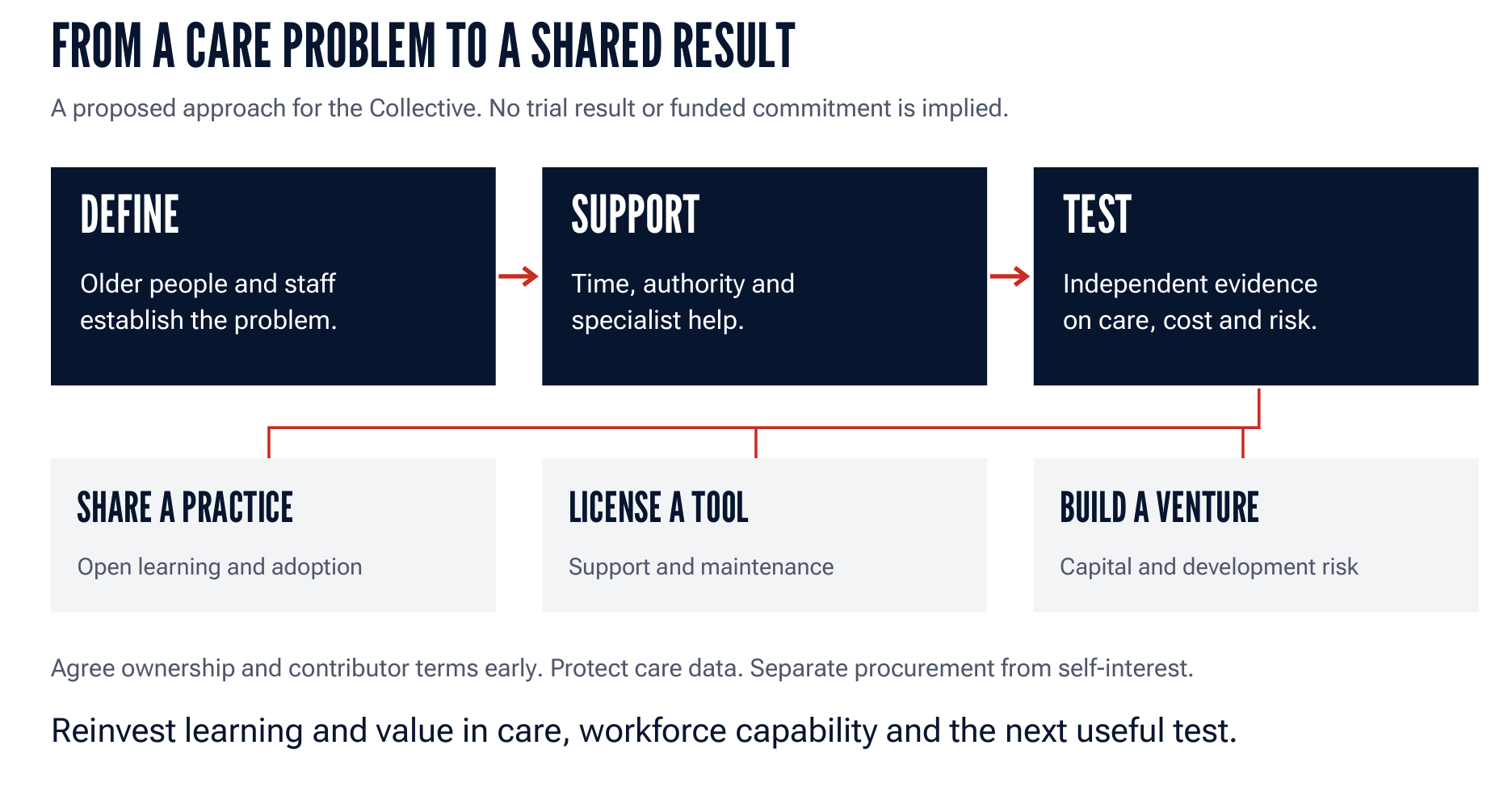
My proposed first 90 days would be modest enough to manage and useful enough to learn from. In the first month, define the problem, secure participation and measure the starting position. In the second, test a bounded change with practical support. In the third, compare the result with the baseline, review unintended effects and publish an honest account of the effort and cost.
That is a proposal for how to proceed, not an announcement of a funded programme or a completed trial. Shared capability has to be paid for. Depending on the project, contributors might combine provider resources, partner expertise, philanthropy or a suitable grant. The decision should follow a defined need, with enough provision for evaluation and ongoing support.
As the work develops, we will need transparent decisions about project selection, commercial relationships, contributor recognition and access to results. The Collective should be open to tools from different builders and to the conclusion that the best answer is a change in practice rather than more software.
Bring something you are prepared to work on
I want optimism to mean something here. To me, it means being willing to examine an uncomfortable result, try a different approach and tell others what actually happened. It leaves room for disagreement and for a test that does not work.
There are reasons to have confidence in the people doing the work. In the government’s 2025 Residents’ Experience Survey, 89% of respondents would recommend their home and 96% reported respect, safety and kind, caring staff. At the same time, positive food experiences remained at 69%, and satisfaction with follow-up on concerns was 85%.[16]
We can recognise that progress and still want a better day for the resident waiting for assistance, the family chasing an answer or the worker trying to complete a task through three systems. Those experiences give us specific problems to work on.
If you work in a service, bring one task that gets in the way of good care. If you are an older person or family member, bring the part of the experience you want changed. If you lead a provider, consider offering a bounded test with staff time and appropriate safeguards. If you build or evaluate solutions, help make that test useful.
I am not asking people to set aside their concerns about government policy. I am asking us to bring the same energy to the choices we can influence, and to build better evidence for the choices that require government action.
After Cairns, I do not want to lose the possibility that sat behind those lunch conversations. Experienced people were frustrated because they could see that there ought to be another way. Let us give that thought somewhere to go.
Join the Care Economy Collective. Bring one problem, one useful skill or one idea you are prepared to help test. I would like our next conversation to include something we changed together.
Practical questions and next steps
Questions I would put to a board
- Can management reconcile the statutory result, recurring care operations, cash and capital obligations?
- Which three workflows create the largest avoidable burden, and how was that established?
- Who has authority and protected time to improve them with residents and staff?
- Which benefits are cash savings, service capacity, care outcomes or potential commercial income?
- Are implementation, checking, support and failure costs included?
- Who independently evaluates the result and decides whether it expands, changes or stops?
- How will fair contribution, privacy, IP and procurement conflicts be handled?
- What will be shared so another service does not have to repeat the same learning?
A proposed first 90 days
- Days 1 to 30: select one workflow and one willing team; involve residents and staff; agree ownership, scope, baseline and stopping conditions; cost the test.
- Days 31 to 60: run a bounded test with backfill or protected time; track exceptions, workload, care experience and errors; review weekly.
- Days 61 to 90: compare against baseline; review costs and unintended effects; decide whether to adapt, stop or expand; publish a usable account with appropriate permissions.
- This is a proposal for discussion. No participating provider, funding commitment, evaluation result or financial return is implied.
Worked examples and assumptions
- Reporting: 4,000 events × 4 minutes ÷ 60 = 266.7 hours/month gross. Subtract 80 hours checking and exceptions plus 20 hours support and training = 166.7 hours/month net capacity. A wage-rate valuation is not itself a cash saving.
- Occupancy: 100 beds × 5 percentage points × 365 days = 1,825 additional occupied bed days. At an assumed $200 contribution after additional care and service costs = $365,000/year contribution to remaining fixed costs. Additional staffing and safe capacity must be included in the assumption.
- Both are synthetic illustrations. They are not forecasts, case-study results or measured benefits of Collective tools.